
Running clean
The vane swings open, the fan spins up, and the noise settles into a steady hum. The panel stays clear and the housing is free of dust. This is what a mini split pulling heat out of cold New Hampshire air should sound like all winter.
A mini split that cranks, buzzes, or clicks through a New Hampshire winter is usually working through ice. The outdoor unit pulls heat from air that might be well below freezing, so it runs a defrost cycle to melt the frost building up on its coil. You'll hear a whoosh or a hiss when that kicks in, and a thump or click when it switches back to heating. That's normal on a cold night. What isn't normal is grinding, rattling, or a noise that keeps going well past the defrost cycle. That points to ice that's built up faster than the unit can clear it, a fan blade hitting something it shouldn't, or a part working harder than it should to keep up with the cold. Left alone, a unit fighting ice all winter loses efficiency right when you need it most, and on New Hampshire power rates that shows up fast on the bill.
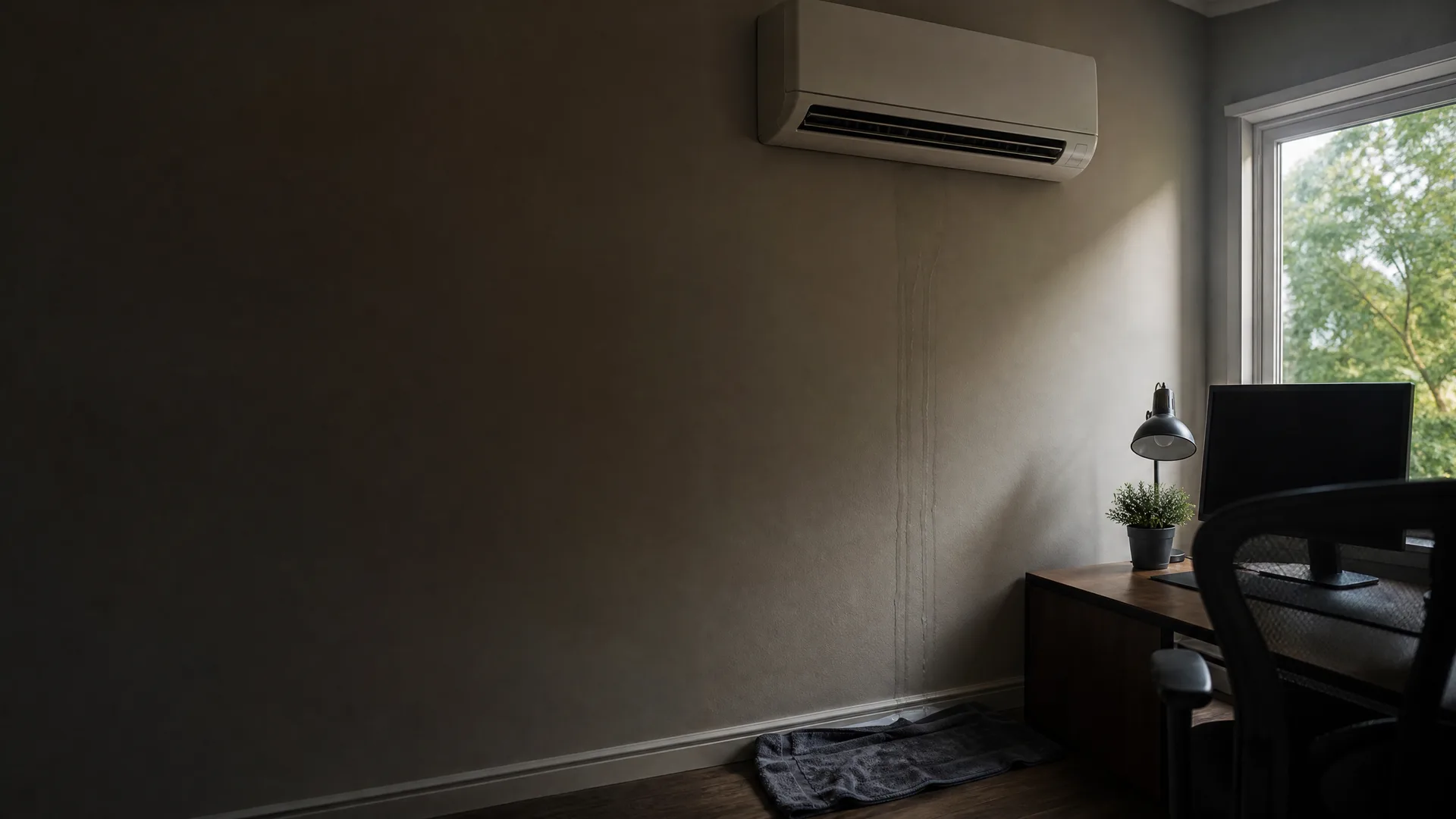
You're at the desk in the home office, working through the afternoon, when you notice the sound under the mini split has changed. Then you see it: a wet streak down the wall below the indoor unit, dark against the paint. You grab a towel and lay it on the floor where the drip keeps landing. Outside, it's a mild New Hampshire summer day, nothing like the heat you'd get further south, but the unit's been running steady since morning. You stand there a minute, listening to it hum, watching the streak creep lower, trying to decide if this is something you can wipe up and forget or something that's going to come back tomorrow.
The reversing valve is what lets a mini split heat your home at all. In defrost mode, it switches the flow so the outdoor coil briefly runs hot instead of the indoor coil. That melts the frost in a few minutes, then the valve switches back. The clunk you hear is that valve moving. A valve that sticks, or clicks over and over without finishing the cycle, is one a contractor can test and replace.

Most houses in New Hampshire heat with oil, so a mini split is often running as backup or as the only heat in one room, not as the main system the household is used to listening for. People notice its sound because they aren't used to it the way they're used to a furnace cycling. That's worth knowing when you're deciding if a noise is new or just unfamiliar. A mini split pulling defrost cycles through January and February is doing what it's built to do.

The reversing valve has a solenoid that shifts a slide inside, and that slide doesn't always move cleanly. A sharp clack or a stuck hum right as defrost starts or ends usually means the valve is worn or the solenoid coil is weakening. The system can still heat the house while this happens, which is why people put off calling. But a valve that hangs partway can leave the outdoor coil half iced, and the unit keeps calling for defrost without finishing the job. That's when the noise stops being occasional and starts being constant, right through the stretch of winter when the house needs the heat most.
This is the kind of failure that looks the same from across the room every time, but the cause is different machine to machine depending on how old the valve is and how it was installed. Someone who works on mini splits all winter in this state has seen enough of them to know which sound points to the solenoid, which points to a sensor feeding the defrost board bad information, and which is nothing more than ice doing what ice does. Getting matched with a contractor local to you means one person looks at your unit, not three competing for the job, and tells you straight whether it needs a part or just time.


The vane swings open, the fan spins up, and the noise settles into a steady hum. The panel stays clear and the housing is free of dust. This is what a mini split pulling heat out of cold New Hampshire air should sound like all winter.

Dust has built up across the housing and the vane only opens partway. A unit in this shape has to work harder to push air through, and that extra strain often shows up as a rattle or a whine that wasn't there before.




Your request goes to one pro, not a list of companies.
It costs nothing to send, and you don't have to hire anyone.
A mini split installed with a slight tilt toward the wall sheds its defrost water inside the case, where it drips onto electronics or runs down into the room below instead of outside.
The same unit tilted a few degrees the other way, toward the outside wall, lets that same defrost water run off the back and down the exterior siding where it belongs.
At 24.53 cents per kilowatt-hour, every extra cycle your mini split runs to fight ice costs more here than almost anywhere else. A unit stuck clicking through defrost over and over isn't just loud, it's pulling power the whole time it struggles.
EIA-861 2025 statewide residential average
When the temperature drops into single digits, your mini split works harder to pull heat from that thin, cold air. Defrost cycles come more often, so you'll hear the fan stop and the hiss or clicking start up every hour or so instead of every few hours. This is the unit doing its job in weather it wasn't built to make easy. The noise should still follow the same pattern each time: a pause, a shift, a return to steady running. If the pattern holds, the unit is keeping up even though it sounds busier than it did in November.
On a stretch of days near or above freezing, the same mini split barely needs defrost at all. The outdoor coil doesn't load up with frost the way it does at ten below, so the reversing valve stays put for hours at a time and the unit runs quieter than you've heard it all winter. If you notice clicking or hissing during one of these mild spells, that's worth paying attention to. A defrost cycle that shouldn't be needed yet is a different problem than one running on schedule in a cold snap.



New Hampshire summers don't carry the heavy air you get farther south. Averaged across June, July and August, the dew point here runs 59°F, which is on the comfortable side as these things go. That matters for the noise question because a mini split working against thick, humid air runs its compressor harder and longer, and that extra load shows up as sound. Here, summer isn't what's driving the clicking or hissing you notice. If your unit is loud, look to winter and the defrost cycle, not the muggy months, because the muggy months barely tax it. Source: NOAA climate normals
NASA POWER T2MDEW county cells weighted by homes


Most of what you hear through a New Hampshire winter is the unit doing what it was built to do. Cold air holds little heat, so the outdoor coil frosts up, and the system clicks into defrost to melt it off before it tries again. That cycle has a rhythm to it. The fan slows, the valve clicks or hums, the hiss comes and goes, then the sound settles back to the steady run you had before. If that's what's happening at your house, the unit is working, not failing.
What's worth a call is anything that breaks that rhythm. A grinding sound that wasn't there last season. A hum that drags on instead of resolving into quiet. Water that shows up on the wall below the indoor unit instead of staying outside where it belongs. Any of those point to something specific, a worn reversing valve, a unit mounted with the wrong tilt, ice that isn't clearing the way it should, and all of them get worse the longer they run unchecked.
Someone who services mini splits in this state through a full winter has already heard most of what your unit is doing. They know which sounds are the system defending itself against the cold and which ones mean a part is wearing out. When you request service here, you're matched with one licensed local contractor, not a handful competing for your callback, and they come in already knowing what to listen for.





The pro who reaches out is licensed in New Hampshire.
No charge to send it. You decide if you hire them.
